Monday, February 16, 2015

At Last, a Book

Dear Eye on the Struggle Blog Readers,

For the past two to three years you have been reading blog entries about Ethel Payne the subject of my forthcoming biography. Thank you for having been along for the ride. But now I can remove the word forthcoming. As of February 17, the book is available for sale wherever books are sold.

Already I have been very fortunate. Reviews that have appeared before publication have been extraordinarily positive.


“Important and often absorbing new book . . It’s a deep pleasure to meet Ethel Payne. ‘We are soul folks,’ she declared in 1967, ‘and I am writing for soul brothers’ consumption.’ Her own soul beams from this book..”
The New York Times

“In James McGrath Morris’s compelling biography Eye on the Struggle, this ‘first lady of the black press’ finally gets her due. Morris lovingly chronicles Payne’s dedication and her rise. . . For her, being a reporter was about 'stretching the horizon of the heart.’ Never content simply to ‘live and let live,’ she sought always to engage, fight and make change.”
O Magazine

Eye on the Struggle is a fast-paced tour through the highlights of 20th-century African-American history, with Payne as witness.”
Boston Globe

 “Morris’ well-paced narrative not only walks readers through the civil rights movement’s inner workings, but he lets us tag along with Payne on her 13 journeys to Africa and trips to China, Vietnam and elsewhere.”
Minneapolis Star-Tribune

 Eye on the struggle is the compelling biography of journalist, Ethel Payne, the ‘First Lady of the Black Press,’ a significant figure in the civil rights era.
NBC.com “14 Books to Read this Black History Month.”

“At long last, this journalistic pioneer, who traveled and covered the world, not to mention sent shivers down the spine of our strongest presidents during press briefings, is getting her due in James McGrath Morris’ absorbing new biography “Eye on the Struggle: Ethel Payne, the First Lady of the Black Press.”
Patrik Henry Bass, who assembled “Ten Standout Titles” for Essence Magazine

"Biographer Morris (Pulitzer) details Payne's work, preserving her legacy and filling in part of the missing history of the fight for equality. . . The rich use of sources and glimpses of Payne's personal life will engage readers interested in civil rights, journalism, and women's history.”
Library Journal

“A deeply researched, skillfully written biography.”
Kirkus

“Crisply illuminating portrait.”
Booklist


Monday, February 2, 2015

A Pioneering Reporter's Autobiography Back in Print

Among the remarkable figures one meets in Eye on the Struggle is Alice Dunnigan. The daughter of a Kentucky sharecropper, Dunnigan overcame daunting obstacles to become the first black woman in the Washington Press Corp, a difficult feat as the solidly white group of reporters controlled much of the accreditation process.
    Dunnigan’s autobiography entitled A Black Woman’s Experience—from Schoolhouse to White House was originally published in 1974 and has been out-of-print for a long time. This year, however, under the loving care of Carol McCabe Booker, the book is back in stores under the new name Alone atop the Hill. Booker has done a wonderful job of bringing it back into print and her editor’s notes are terrific. You can learn more about the book here.
    Below is an excerpt from Eye on the Struggle in which I introduce Dunnigan to readers.

Note: Carol McCabe Booker and I will both be on panel discussing our books at the National Press Club on February 25th. Click here for more information about the event.

___________  


Dunnigan, a reporter for the Associated Negro Press (ANP), was the first African American female journalist accredited by Congress and the White House. The daughter of a Kentucky sharecropper, at thirteen Dunnigan had set her sights on being a reporter and never let any obstacles get in her way. In 1948, for instance, when Truman took off on a fifteen-day, 9,000-mile train trip that would presage his famous fall campaign whistle-stop tour, Dunnigan paid her own way by taking out a loan after her boss at the ANP, Claude Barnett, refused to approve the $1,000 travel costs. Her boss’s stinginess was a result of sexism rather than parsimony. “I did not think a woman could do the best job on a jaunt of that kind,” he said.

Female reporters had first been seen at presidential press conference during the Franklin D. Roosevelt administration, when two women joined the all-male White House press corps. But their entry didn’t signal an acceptance of women on the hard news side of the media. In fact, two years earlier Barnett had only hired Dunnigan to work for the ANP because all the men he approached turned down the pitiful salary he offered. She took the job in return for the title of Washington bureau chief and a low piece rate that was eventually converted to a salary of $25 a week. To make it work, she moved into a basement apartment of a white family’s house, tending the furnace and hauling the ashes to reduce her rent, eating Sunday meals of pig ears and turnip greens, and pawning her jewelry when her paycheck was late.

When she boarded Truman’s train in June 1948, Dunnigan was the first black newspaperwoman to travel on a presidential trip. She was such a rarity that when the train stopped in Cheyenne, Wyoming, a white military policeman thought she didn’t belong in the phalanx of reporters walking down the street behind the car ferrying the president to the capitol building. “Get back there behind this line where you belong,” the police officer called out. When Dunnigan continued to walk, he grabbed her and tried to forcibly direct her toward the sidewalk. But before he could, a young correspondent for the Nashville Tennessean stepped in. “I want you to know,” he told the MP, “you are messing with the party of the president of the United States. You know this woman is with us. She has her badge and she has it on.” The MP backed off.

A couple of days later, Dunnigan sat in her train compartment, her shoes off, her bare feet on the seat, and her typewriter on her lap, when there was a knock on her door. In walked Truman. “I didn’t know what to do,” she said. “I tugged at my skirt. I couldn’t find my shoes. I knew I should be standing up, but I couldn’t move.”

“I heard you had a little trouble,” Truman said in a quiet voice. “Well, if anything else happens, please let me know.”

Saturday, December 6, 2014

Ethel Payne and Selma

"Selma" the movie is coming to theaters this December. Here is an excerpt from Eye on the Struggle relating to the march.


The following spring, the civil rights movement made it clear that its legislative business was not done. On Sunday, March 7, 1965, protesters in Alabama seeking to draw attention to the state’s insistent use of Br’er Rabbit–like trickery to keep blacks off the rolls of registered voters began a march from Selma to the state capital in Montgomery. State police used deadly force to halt the march as it crossed the Edmund Pettus Bridge, only hundreds of yards into its planned fifty-mile journey.

A week later, President Johnson came to Capitol Hill to address a joint session of Congress. Payne secured a seat. She did not want to miss this moment. As a voting rights organizer for the Democratic Party, she was anxious to see what the president was willing to do to back up his stated intentions of following up the 1964 Civil Rights Act with a federal voting rights law. The violence that met the group drew national attention to their cause and was forcing his hand.

When Johnson rose to the dais on the floor of the House, more than seventy million Americans tuned in on their televisions to see what he had to say. In the gallery above, Payne listened in amazement. In sonorous tones and in his distinct drawl, Johnson spoke in almost religious terms of the right to vote, making almost no reference to the Constitution or laws. Rather, he focused on an elusive idea of the “American Promise” and represented it in a narrative in which the time had come to grant the final act of freedom to its black citizens. “As a man whose roots go deeply into Southern soil, I know how agonizing racial feelings are,” Johnson said. “I know how difficult it is to reshape the attitudes and the structure of our society.”

All who listened knew the speech was unlike any the president had given before. They witnessed a rare moment in politics where quiet eloquence silenced noisy opposition. The events in Selma, Johnson said, were part of a movement that reached into every part of the nation. African Americans were securing for themselves the freedom they had long been denied. “Their cause must be our cause too. Because it’s not just Negroes, but really it’s all of us who must overcome the crippling legacy of bigotry and injustice.” Then, pausing
and leaning forward, Johnson repeated the words of the movement’s anthem, “And we shall overcome.”

Payne could not find words to describe her feelings at the end of his speech. Two days later, in her office, she sat at her typewriter. “I would like every schoolchild in American to have a copy of this speech,” she wrote the president. It ranks in importance, she said, with Lincoln’s Gettysburg Address and the Emancipation Proclamation. “I am proud and grateful for your leadership and I pledge to give my best efforts for the implementation of your program.”

Taking her pledge to heart, Payne flew to Selma to join the third attempt to make the march to Montgomery, but this time with the backing of a federal judge, who enjoined the police from stopping the marchers, and federal troops summoned by the president. Nonetheless, it was like stepping into the lion’s den. “You could just feel the hatred,” Payne said. “It was just like an enveloping cloak around you.”

At the spot where the earlier marches had been halted, hundreds of angry white Southerners, infuriated by the presence of federal troops, watched as 3,000 marchers crested the Edmund Pettus Bridge and descended toward them while army helicopters hovered above. Held back by a line of soldiers with bayonet-tipped rifles, the angry whites waved Confederate flags and racist placards. “I’ll never forget the faces, the contorted faces of housewives, standing out and screaming like they were just lunatics from the asylum, you know, just screaming such terrible epithets and hatred,” said Payne. They called out “Nigger, nigger, nigger!” and “Go to hell,” and cursed President Johnson. “The reaction of the people was so vitriolic,” Payne said. “You never realized how deep human hatred can be. And that was the way it was all along the march.”

Another life was taken. Klan members murdered a thirty-nine-year-old Detroit mother of five, Viola Liuzzo, for having given a ride to a young black protester. “This was a madness, just a total madness,” Payne said. “This was a time when all—it was a purging of the white South, all the venom that came out, and perhaps it was good, because it was just boiling over, and it was such an excess. It was a preparation for later acceptance of what they knew was inevitable.”

The police attack on the marchers and the ultimate success of the march impressed Capitol Hill. The Senate minority leader, Republican Everett Dirksen, joined the majority leader, Democrat Mike Mansfield, in supporting a bill like that demanded by the marchers in Selma. By August a bill was on the president’s desk granting the federal government immense judicial powers to end Southern methods of keeping their black citizens from the voting booth.

A Johnson aide was dispatched to deliver to Payne one of the pens the president used in signing the Voting Rights Act. Aside from Martin Luther King, she became one of the very few people who were not lawmakers to have a pen from the signing of both the 1964 Civil Rights Act and the 1965 Voting Rights Act, the two most seminally important legislative victories of the civil rights movement. She put both pens on display in her apartment.

Sunday, November 23, 2014

Mayor Marion Barry (1936-2014)


Marion Barry, four-term mayor of Washington, has died. Ethel Payne crossed his path several times. Here is an excerpt from EYE ON THE STRUGGLE about one such encounter late in her life. The Capital Press club mentioned here was an African-American alternative to the National Press Club, which did not then accept black members until 1955.

Pages 376-377
But the cane-toting Payne remained a reporter to the last. Mayor Marion Barry, once a well-known and militant civil rights leader, was in his third term as mayor of Washington, DC. The city government was in shambles and the murder rate had reached record levels. Under investigation for his connections to a drug suspect, Barry continued to vehemently deny his not-yet-publicly-known addiction to cocaine. He agreed to speak to the Capital Press Club, perhaps believing he would avoid the kind of questioning he had been receiving from the white media.

“Mr. Mayor,” asked Payne, who had known Barry for decades, “if you had it to do over again, what mistakes would you acknowledge?” Barry replied that he had no errors to admit. Instead he asked Payne for her opinion of him. The question was a mistake. “I think,” she said, “you have a whole pile of stuff to contend with.” An uncomfortable silence descended on the room and the mayor smiled uneasily

Wednesday, September 24, 2014

The Ida Initiative & Ida B. Wells and Beyond Conference

In many ways as a twentieth century journalist, Ethel Payne was an heir to the pioneering work of nineteenth century newspaper reporter Ida B. Wells-Barnett. Both used journalism to advance the cause of civil rights, both sought through writing to bring about social justice, and both were women ahead of their times.

As a tribute to as well as an effort to document the work of Wells-Barnett, the students at the University of Tennessee’s School of Journalism & Electronic Media are constructing a website devoted to chronicling the story of the remarkable woman.

Students Hannah Cather has posted a biography; Dylan Wilkes has written about her legacy;  Casey Black has expound upon her journalism; Jennifer Brake detailed her work as a suffragist; and Marion Kirkpatrick explained her work on behalf of women's rights.

There is more to come. So be sure to visit the site more than once.

In addition to this website, the School of Journalism & Electronic Media at the University of Tennessee, Knoxville, will host a special conference "Ida B. Wells and Beyond." The conference will be held in conjunction with the 40th Annual AEJMC Southeast Colloquium, March 26-28, 2015.

If you are interested in participating, the announcement explains that scholarship should focus on the life, career and legacy of Ida B. Wells-Barnett or the work of like-minded social justice crusaders in the nineteenth, twentieth, and twenty-first centuries. To learn more contact Amber Roessner, the research chair.


Tuesday, March 4, 2014

Dinner with the Lorches in Little Rock


Desegregation activist Lee Lorch recently passed away. David Margolick, the author of Elizabeth and Hazel: Two Women of Little Rock, penned the New York Times obituary.  You can read it here.


Lee & Grace Lorch with their daughter.
In 1957, Payne travelled to Little Rock to cover the famed Central High School desegregation standoff between Governor Orval Faubus and the Federal government. The following is a short account of Payne’s visit with Lee and Grace Lorch, both of whom were remarkable and unsung heroes of the era, drawn from my forthcoming book.

After a night’s rest in a private home, Payne received a dinner invitation from Lee Lorch, a white mathematics professor at the small black Philander Smith College in Little Rock. The two had met the previous year when Payne was traveling for her “South at Crossroads” series. In fact, she had written two articles about Lorch, tracing his repeated firing from colleges as an example of the treatment accorded to whites that joined the civil rights movement. “Lee Lorch and his family had been hounded through four states from the North to South like refugees in displaced camps,” Payne had told her readers. “And in the process of punishing Lee Lorch for his views, three proud institutions of learning have been made to grovel in the dust and bow the knee to bigotry.”
      Payne was particularly interested in reconnecting with the Lorches because on the day Eckford had faced the troops and the mob, it had been Grace Lorch who had stepped forward to protect the young student as she sat alone on the bench at the bus stop. Enduring catcalls, Lorch had remained with Eckford until she safely boarded a bus. Payne was also hankering for some decent food. “The restaurant situation for Negroes in Little Rock is worse than bad,” she said.
      Lee Lorch picked up Payne from the house where she was staying. As they drove through town, Lorch said it was the first time they had a guest over to their apartment overlooking the capitol building and he cautioned Payne that something untoward might be said.
      At the building they entered the elevator operated by a young black woman. “I don’t believe I ever got your name,” Lorch said to the woman.
      “Frankie,” she replied.
       “Oh, but you do have another name, don’t you?”
       “Sure, it’s Frankie Coleman.”
        “Miss or Mrs.”
        “Mrs.” replied Coleman, at which point Lorch introduced Payne calling the operator “Mrs. Coleman.”
       “Frankie, looked slightly non-plussed at this departure from southern tradition,” said Payne, “but new gal of the South as she is, she didn’t quibble over the fact that I was riding in the front elevator.”
      As soon as they reached the apartment the telephone rang. The manager was calling because he understood that the Lorches were “entertaining a colored guest and this was in violation of the rules and when would he be vacating?” Lorch replied he knew nothing of the rule and “he was accustomed to entertaining his friends, whatever their pigmentation happened to be.”
       The following morning the Lorches received an eviction notice. “Right now,” Payne reported to her readers, “Little Rock to me is about the crummiest corner on the map. When I got home, Henry Cabot Lodge was on TV sounding off at Russia and giving the commies hell. Well, he should be in Little Rock now and see what’s going on.”

Wednesday, August 28, 2013

Payne's Deep Roots with the March on Washington

The famous 1963 March on Washington had its origins in the 1941 March on Washington Movement launched by A. Philip Randolph to desegregate the armed forces and open up jobs to African Americans in the booming war industries.
   Ethel Payne, who at the time worked for the Chicago Public Library, became a trusted lieutenant in Randolph's movement and remained friends with him over the years.
   On August 28, 1963, although no longer a reporter, Payne joined her old colleagues in the press seats as more than 200,000 demonstrators converged on the Lincoln Memorial. The last time there had been such gathering was the smaller Prayer Pilgrimage for Freedom, which Payne had covered six years earlier for the Defender.

    Randolph provided opening remarks when the crowd reached the monument. Bayard Rustin paid tribute to black female activists, but highlighting their continued exclusion from leadership posts they were absent from the list of scheduled speakers. Payne’s Little Rock friend Daisy Bates, however, was given a brief moment at the microphone and pledged that women would sit-in, kneel-in, and lie-in to support the struggle.
   As the program neared its end, King rose to the deliver a speech intended to serve as the centerpiece of the rally. He had finished it early in the morning, before the sun rose, and a copy had been distributed to the press. As he began to read, the audience reaction was palpable from where he stood on the stairs of the monument.

   Seized by the moment, King put aside his script and instead extemporaneously talked about a dream he had been using in recent speeches. “I say to you today, my friends,” said King, “that in spite of the difficulties and frustrations of the moment, I still have a dream.” In words that would be carved on monument and recited by schoolchildren for generations, King began to speak of his vision. “I have a dream that my four children will one day live in a nation where they will not be judged by the color of their skin but by the content of their character.”
   It was clear to Payne that King had given up on following his prepared remarks.  The reporters around her couldn’t follow the copy of the speech they had been given.  “It was truly a spiritual message,” she said. “I saw white and black veteran reporters seated near me with tears in their eyes, stream down their cheeks. I had tears, too.”
   A few days later, while staying at the Sheraton-East Hotel in New York, Payne took out a piece of the hotel’s stationery and wrote to Randolph. “Dear Phil,” she began, “We are still glowing from the great experience of the March last Wednesday. Remembering 1941 and 1942, I can say I’m glad that at long last your dream did come true.


Thursday, June 27, 2013

The Day Payne Met Mandela

In May 1990, a year prior to her death, Ethel Payne had an opportunity to travel to South Africa to meet Nelson Mandela, who had just been released from prison a few month earlier. “A palpable elation suffused her spirit as the trip’s logistics began to materialize,” recalled Joseph Dumas, a young journalist whom Payne was mentoring at the time. Fatima Meer, an Indian-born South African anti-apartheid activist with whom Payne had corresponded over the years, made all the arrangements. She had been imprisoned with Winnie Mandela in 1976 and had just published Nelson Mandela’s biography.
    At ten on the morning of May 24, Payne arrived at the Mandelas’ new house in the Orlando East section of Soweto. Payne spotted the armed security officers from the ANC guarding the perimeter and gained her first look at the controversial house whose construction she had defended two years earlier. Three-stories tall, with four bedrooms, she found it, in her words, “to be tastefully furnished, but not lavish.”
    In the living room, Payne drank coffee with Winnie Mandela, whom she met for the first time after years of correspondence. Nelson Mandela greeted Payne while still clad in his pajamas. The two sat down and he answered her questions for thirty-five minutes, twenty more than the fifteen-minute audience that had been promised. Payne asked about the ongoing negotiations with the government and resistance among white South Africans. Despite his imprisonment, Mandela remained conciliatory in freedom. “The majority of whites want to see a peaceful change,” Mandela told her. “Whites have nothing to fear from sharing power with all the people of South Africa.” Payne was amazed at Mandela’s attitude. “Ethel could not understand why Mandela was not angry,” said C. Payne Lucas of Africare who saw Payne upon her return to the United States.
    The interview completed Payne, dressed in colorful floral outfit with a long strand of pearls, stood next to the much taller Mandela in his red bathrobe tied closed with a cord. When she returned to the United States Payne told her friends that lots of reporters had interviewed Mandela since his release but she was the only one to have done so while he was in his bathrobe.

Monday, March 25, 2013

The Forgotten King

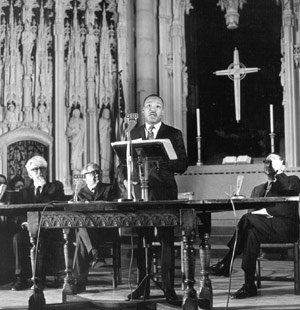
King giving his "Beyond Vietnam" speech in April 1967
Toward the end of his life, Martin Luther King spoke out against the Vietnam War and took on a more radical tone in his criticism of American society. In public remembrances of the man, this chapter of his life is sadly often overlooked. His criticisms remain very relevant today.
      In early June 1967, Ethel Payne covered a speech King gave at the Capital Press Club annual gathering in Washington. The club had been created 24 years ealier because the National Press Club barred blacks from membership.
   There had been considerable debate among the Capital Press Club leaders about having King speak. In April he had come out against the Vietnam War. Since then many of his movement colleagues, including the NAACP, had disassociated themselves from any effort to connect their rights movement with the peace movement. His allies in the white press deserted him, as well. The New York Times said that by fusing race and peace King had done a disservice to both causes. The Washington Post said that his stance had diminished his usefulness to his cause and country.
            Even Payne's newspaper, the Defender, joined the chorus of critics. First, it did so by putting Payne’s account of how GIs viewed the war on the front page a week after King’s speech. In her article, she reported that ninety-nine percent of the men she interviewed while in Vietnam a few weeks earlier supported the war. “Negro soldiers, “ she wrote, “tend to equate the struggle of the Vietnamese people with the civil rights movement at home.”  Eleven days later, the editorial page made the Defender’s views clear. Saying that King “had been swept along by the prevailing tide of hysteria against the war in Vietnam,” the paper predicted, “he will be a shepherd without flock.”  

          “He knew he was under siege for his views,” said Payne who sat not far from him at the club dinner. “As a Negro who knows that the focus of the pro and cons of the war are centered on the American Negro now more than ever, he must have felt that this dinner meeting of the Capital Press Club was a particularly good forum for expressing himself.”
            King began by recalling the halcyon days of the movement in the 1950s and early 1960s and its great legislative victories in 1964 and 1965. “Now, we are moving in a transition period, moving from one phase of the revolution to another,” he said. “We are in a struggle for genuine equality.” The early gains, such as opening hotels, transportation, and restaurants, were won at a “bargain rate,” King continued. Finding jobs for Negroes and eradicating the slums lie ahead. “By this time,” said Payne, “the audience was so quiet one could have heard a mouse running over velvet.”
            In his inimitable slow and rhythmic cadence, King continued. “There must be a radical re-distribution of economic power,” he said.  Whenever the government funds a poverty project in Mississippi, it is labeled creeping socialism. “In this country there is socialism for the rich,” King said. “Only the poor are cast out into the unproductive world of free enterprise.”           
            “By this time,” said Payne, “the audience had come alive and the applause was at steady intervals, but a hush fell again as Dr. King approached the third phase of his speech on the subject of war.” Without mincing words, King repeated his criticism of the war and claimed that women and children have been brutalized and others have been victims of napalm. Charges, that Payne claimed in her coverage of the speech were unsubstantiated and  “indicative of the weak spot in the King logic.”
            But King was not done. “To those who say, why don’t you stick to civil rights and leave the peace issue alone, I say, I refuse to be limited or segregated in my moral concern.” The applause was deafening, said Payne. In her eyes King, the dissenter, had won over the crowd. “When he finished there was a standing ovation and it was clear to the hawks and the doves that ‘the conscience of America’ had spoke clear and firmly.”

Tuesday, January 15, 2013

MLK and Changing Fear of Jail

Working my way through the papers of Louis Martin at the Library of Congress I ran across a perceptive observation that he made about Martin Luther King Jr.  As January 21 is Martin Luther King Jr. Day, I thought I would share it.
     Martin was a long-time editor of the Chicago Defender who worked later in the White House. In his unpublished memoirs, Martin said that King's attitude toward being jailed provided important inspiration to other African-Americans in the emerging civil rights movement. It was not that he would simply tolerate being locked up, but that he went willingly into a jail in the South.
     "For generations all blacks lived in mortal fear of jail," Martin wrote. "The sheriff and the police officers were the twenty-four hour enforcers of the doctrine of white supremacy and the legalized abrogation of the constitutional rights of black folks. The cop on the ghetto corner replaced the boos of the slave plantation for thousands and the sheriff and his posse were indistinguishable in many instances from the Klan leader and his lunch mob."

Monday, December 31, 2012

Daisy Bates Captured in Marvelous Documentary

One of the joys of researching a life is encountering wonderful work by other historians and biographers. In this case I recently had the chance to view Daisy Bates: First Lady of Little Rock that premiered on PBS this year. It is the  story of a seven-year journey taken by filmmaker Sharon La Cruise in hopes of unraveling the life of Daisy Bates who became a household name in 1957 when she fought for the right of nine black students to attend the all-white Central High School in Little Rock, Arkansas.
     La Cruise did a masterful job at making Bates human while retaining an appreciation of her historical significance.  I encourage you to watch the film. You can do easily, as I did, by renting it on line for less than $4 or you can purchase a DVD. Visit La Cruise's website to learn more.
     Ethel Payne came to Little Rock in September 1957 at the height of the standoff between Governor Orval Faubus and the students. She met Bates and the two became life-long friends. Payne also spent an afternoon with the nine black students who were keeping up with their studies while the protesters, courts, and ultimately the President decided their academic fate. "It was a refreshing joy," Payne reported to her readers, "to watch this group of bright uninhibited and unafraid kids calm discuss the situation which swirls around them in the angry bilious patterns of race prejudice."
    The photo below to the left of Payne and Bates was taken maybe in 1981 when Payne stopped in Little Rock for a visit.
     "The house on West 28th is a neat, yellow brick rambler," Payne wrote of her return visit. "It is surrounded by spacious lawns to the rear and side. Red roses climb the wire fence. The street is lined with well-kept, modest homes, typical of the solid citizens who inhabit them. They are the friends and neighbors who keep a protective watch over the occupants of the place. Though not designated yet as a landmark, it is part of history.
    Daisy Bates lives here alone with three cats to keep her company. The house is tastefully furnished, immaculate, and filled with memorabilia--the plaques that lines the walls, trophies on stands, thousands of photographs and books.
     Well, it should be for the frail woman, now in her 60s, has as much to do with the changing pattern of segregation in America as any one single individual. L.C. (Lucius Christopher) Bates the man who stood with her in the long, bitter struggle, is gone now. Death took him last August."
    A few blocks away from the street is Central High School. Nearly 24 years ago, it was the scene of violent confrontations, and resistance to court ordered desegregation. . .
    The front of the school looks the same with the same big letters, 'Little Rock Central High School' and the life-sized painting of a tiger on the wall. All is quiet now. A few blocks away, the woman who made it possible sits stroking her pets and remembering the fire storm that it took to bring about change."

Monday, November 12, 2012

Payne Rejoiced at Washington's Mayoral Election


source: Brent Jones, Amistad Digital Resource
If Ethel Payne were alive today she would be incredulous at the sight of an African American family occupying the White House. In her time, Payne did experience a similar triumph, though on a smaller scale, when a coalition of African Americans, Latinos, and poor whites put Harold Washington into Chicago’s mayor’s office in 1983.
     The victory came in two parts: First, he managed to beat the incumbent mayor, Jane Byrne, and the son of past mayor Daley, Richard M. Daley. Second, frustrated Democrats unwilling to support a black candidate made one last desperate attempt to thwart Washington’s election by supporting the white Republican candidate. For a while the slogan for the Republican campaign was “before it’s too late,” until wiser heads prevailed. The only issue with which they gained traction was that Washington had once done prison time for failing to file federal income tax returns.
     Payne watched the election from her post as a professor at Fisk University. “Like so many of exiles whose hearts have never left Chicago,” she said, “I went ape when it was finally officials that Harold Washington had won the Democratic primary.”
     Payne returned to her native Chicago at the end of April 1983 to attend Washington’s inauguration. A few days later Payne told a friend about the experience. “For me,” she said, “it was quite an emotional experience, something I never dreamed of seeing in my lifetime. Far more than the matter of color is involved here. Despite the repetition and exaggerated accounts of his tax problems, he is a refreshing example of morality in public office. He has courage and integrity, and best of all the strength to hang tough.”

Wednesday, June 13, 2012

Dinners to Remember


Payne with friends in her apartment.
Almost anyone who came into contact with Ethel Payne remembers her dinner parties. For Payne a meal at her place was a way to bring interesting people to the table. Many well-known people host dinners so they can hold court. Not so with Payne. She was the opposite. Her dinner parties were a chance to let others shine.

She chose her guests carefully and from a wide array of people. “Lord only knows who you were going to meet,” said one guest. Normally more than six people were invited. All selected with an eye to create great conversation.

Food was, of course, important. Southern food, lots of greens, sweet potatoes and the like, were often on the menu along with nice wines. “You put Betty Crocker, Aunt Jemima, Maxim’s and the Tour d’Argent all to shame!” wrote one person in a thank you note.

But now twenty-one years after Payne's passing, what the dinner guests remember more is the warmth of the evenings, the good companionship, and, of course, the conversations.

If you want to try one of Payne’s recipes, this one for Chili was found in her papers at the Schomburg Center for Research in Black Culture

ETHEL'S CHILE

Ingredients
  • 1 lb hamburger meat
  • 2 16 oz cans of red kidney beans
  • ½ cup chopped onions
  • ½ cup chopped green peppers
  • 2 cloves chopped garlic
  • 2 tbsp canned pimientos
  • 3 oz grated baker’s unsweetened chocolate
  • salt, Oregon, pepper
  • ¼ cup brown sugar
  • 2 tbsp chili power
  • 8 oz tomato paste mixed with 16 oz tomato puree
 Directions
  1. Cook the hamburger meat and drain off the fat
  2. Saute the onions and green peppers.
  3. Add the garlic
  4. Add all the remaining ingredients and let simmer.
  5. Payne suggests serving it over spaghetti.

Thursday, April 5, 2012

The original March on Washington


Courtesy of Chicago Public Library
Ask young people about the March on Washington and they will promptly cite the famous 1963 gathering in front of the Lincoln Memorial at which Martin Luther King Jr. delivered his famous “I Have a Dream” speech. Forgotten by many is the original March on Washington Movement led by A. Philip Randolph in 1941. However, had it not been for this earlier effort the 1963 March might have never happened.
    In 1941 the growing conflagration in Europe fueled a government armament-spending spree that fired up the economy and wiped out the last vestiges of the Great Depression. But to African Americans the economic growth bitterly reminded them of the racial divide. Nearly one in two blacks in Illinois remained without work at the end of 1940. Picking up a copy of the Chicago Defender was discouraging. At the booming Los Angeles aircraft manufacturing plants, the paper’s correspondent reported, only one Negro could be found among the thousands given work. A plant manager in New York told the Defender there was no company policy against hiring Negroes. “He said that objections to working with Negroes undoubtedly would come from the men already in the plan and that the company did not wish to experiment at this present time because of the possibility of labor difficulties or the impairment of the moral of its workers.”
    After the disheartening racism of the 1920s and bleak years of the 1930s, the patience of urban African Americans was coming to an end. In the fall of 1940 three black leaders met with President Franklin D. Roosevelt to seek an end to segregation in the military and defense industries. Roosevelt listened sympathetically but soon after the White House made known its intention to continue prohibiting the intermingling of colored and white soldiers. The announcement coming so quickly made it seem as if the black leaders had concurred in the pronouncement, especially when the press secretary made mention of the meeting.
     The White House vainly tried to mollify the black leaders. But Randolph, the founding president of the Brotherhood of Sleeping Car Porters, would have none of it. As he rode the train into the South, he brooded over the impasse. By the time he reached Savannah, Georgia, Randolph had a plan. In recent years he had been deeply impressed by the non-violent approach being taken by Mahatma Gandhi in India against colonial British rule. If Gandhi could lead a march to seacoast in protest of the colonial tax on sale, African Americans could be marshaled into a mass action for jobs.
     Proposing his idea first to small gatherings and then finally to the nation in January, Randolph called on African Americans to march on Washington as had Coxy’s Army of unemployed workers in 1894 and the Bonus Army of unpaid war veterans in 1932. Over six feet tall, elegant in gestures, with a baritone voice that one described as being as musical as an organ, Randolph rallied his people with an eloquence in speech and writing that belied his limited education. “The virtue and rightness of a cause,” he said, “are not alone the condition and cause of its progress and acceptance. Power and pressure are at the foundation of the march of social justice and reform.”
    The idea struck terror in the Roosevelt administration. The President turned to his wife, who enjoyed considerable respect among African Americans. With the date of the march drawing closer an anxious Eleanor Roosevelt pleaded with Randolph to call off the march. If the arrival of thousands of blacks upon the nation’s capital, still a deeply segregated city whose hotels and restaurants barred Negroes, triggered an incident of any sort it would set the cause back, she wrote. “You know that I am deeply concerned about the rights of Negro people, but I think one must face situations as they are and not as one wishes them to be.”
    To the President and his wife, as well as to allies such as New York City Mayor Fiorello LaGuardia, the planned protest march was unfathomable especially in time of war. But that was exactly Randolph’s hope. He believed the wartime atmosphere could be used to advance Civil Rights. The march, he promised, “would wake up and shock official Washington as it has never before been shocked” because “Negroes are supposed not have sufficient iron in their blood for this type of struggle. In common parlance, they are supposed to be just scared and unorganizable.”
    He invited African Americans laborers and lawyers, doctors and nurses, mechanics and teachers, men and women, young and old to join in. “To get 10,000 Negroes assembled in one spot, under one banner with justice, democracy and work as their slogan would be the miracle of the century,” proclaimed an editorial in the Chicago Defender. “However, miracles do happen.”
    Throughout the spring and into the summer of 1941, no one could escape the build up to for the summertime march. Each week the Defender reported on the growing plans as well as the mounting efforts of the administration to prevent its occurrence. Finally, with only a few days remaining before the march, a worried President capitulated. On June 25, Roosevelt issued Executive Order 8802 establishing the President’s Committee on Fair Employment (FEPC). Randolph called off the march. In its place, he converted the planned protest into the March on Washington Movement aimed at solidifying the gains and making sure the new commission lived up to its promise.
    Ethel Payne became a believer and an important foot soldier in the movement. But for that part of the story as well as what she and Randolph said to each other after the 1963 march,  you’ll have to wait for the book.

Friday, February 17, 2012

Making World Safe for Democracy Except at Home

Charles White, The Return of the Soldier, 1946 (Lib of Cong.)
When African American soldiers fought in World War II the troops were still segregated. However, many black soldiers came into contact with others overseas, particularly in Europe, who did not share American racist attitudes. The experience made coming home a mixed blessing.
    Ethel Payne's brother, Lemuel, served in the U.S. Army and was among those who experienced the personal liberation of being treated with respect and worried about coming back home.
    “Although he is anxious to return home,” Payne wrote to A. Philip Randolph in September 1945, “he dreads the thought of returning to the old American discrimination after he has had a chance to see some of the liberalism of such places as Paris, Belgium, and even some parts of Germany where the German people despite the verboten of fraternization have heartily welcomed Negro troops.”
    By the thousands, black soldiers like Lemuel returned to the United States changed men. It is no surprise that the Civil Rights movement would find many supporters among these veterans a few years later.


Thursday, January 26, 2012

Even Liquor Was Segregated


“In 1963,” recalled Civil Rights activist Dorothy Cotton, “Birmingham was often called the most segregated city in America.”
    The Civil Rights movement made its fight against segregation in Birmingham a model of direct action that inspired other cities, attracted immense media attention, and helped bring about the passage of the 1964 Civil Rights Act.
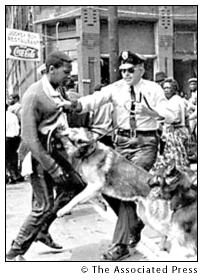
    Ethel Payne came to the city in May to cover the controversial Children’s Crusade in which thousands of students left school and marched. Over several days hundreds of students were arrested, dispersed with powerful water hoses, and even attacked by the notorious dogs under the control of Public Safety Commissioner Eugene “Bull” Connor.
    Payne and other reporters stayed at the A.G. Gaston Motel, where Martin Luther King and other movement leaders camped when in town.
    One night, confined to their rooms by a heavy downpour, the reporters heard a loud knock. Opening the door they found New York Post reporter Murray Kempton dripping wet with a bulky package tucked under his raincoat
    “You all can’t have any of this,” Kempton exclaimed to the black reporters in the room, “this is white folks’ whiskey.”
    Kempton's sarcastic remark was prompted by his discovery that segregation was so rigid in Birmingham that the liquor store where he bought his whiskey had a barrier running down the store.
    “There were certain brands of liquor on the one side for the whites and certain brands on the other side,” recalled Payne. But, in recounting this incident many years later, she added with a laugh, “The cash register was in the middle and it didn’t discriminate.”

Monday, December 26, 2011

Painting China

A plate from the 1876 exhibit (courtesy of Rogers Museum.)
One of the joys of writing a biography is learning about tangential things in the course of one’s research. For example, while researching Ethel Payne’s childhood, I learned that her mother Bessie was a china painter, an art form I knew nothing about.
    It turns out to have been a very popular pastime. The hobby of hand painting and firing china, which some made into a profession, took hold in the United States in the late nineteenth century. An exhibit at the Philadelphia Centennial Exposition exposed millions of Americans to this new art form. “In the early 1900s there were hundreds of unnamed and unknown fine female china painters and artists who lapsed into obscurity because no one felt their lives needed documentation,” according to the Journal of Antiques. “Allowed creative occupations and hobbies, they were never allowed to achieve professional status like their male counterparts.”

   Bessie Payne was among those women who took up the hobby after taking a class, one of many that were taught after the art form gained popularity. She would do her work by drawing patterns on blank china and then fill them in with color. She favored fruits and flowers, according to Ethel. After completing her painting work, she would bake the item in a small kiln she kept in the house.
    “People began asking for these pieces, and at first, she was giving away pieces, and then somebody said, ‘No, Bessie, you should be getting money for this.’”
    “So then she began—she never did it on a large scale, but it was enough to bring in a little extra change,” said Ethel. “But she did beautiful work. Incidentally, she handed it down, the profession, down to one of her grandchildren, who became quite adept at it.”

Wednesday, November 30, 2011

Addendum to the November 27 posting

After I wrote the last posting, I ran across this article that appeared in the August 15, 1953 issue of the Chicago Defender.


Sunday, November 27, 2011

Taking to the Air

As a pioneering black female journalist, Ethel L. Payne was a rarity in her day. She was also unusual among African-Americans in taking to the skies.
    In her day few African-American flew. Until the Civil Rights movement gained traction, air travel remained primarily the province of white travelers. Domestically and internationally, seating in airplanes was not segregated but airports in the American South, where most African Americans lived, certainly were. This included Washington’s National Airport. As early as 1948, U.S. Representative Charles Diggs, of Michigan, tried to persuade Congress to desegregate the airport, which was a federally owned facility. He failed but President Truman interceded to at least force the restaurant at the airport to open its seats to blacks.
    But barriers mattered little to Payne. Starting in 1951, when she flew home from a three-year tour as a service club hostess in Japan, Payne began a lifelong accumulation of air miles that might even exceed that of the modern traveler.
    In 1955 Payne went back to Asia as a journalist to cover the remarkable Bandung Conference in Indonesia and followed it up with a round-the-world journey. In 1957, she was off to Ghana to cover the celebrations, as it became the first sub-Saharan African country to gain its independence. In the years that followed she went to Vietnam, to cover the war; Nigeria, to cover its civil war; on two multi-nation African trips with U.S. Secretaries of State; Europe, for peace and disarmament conferences; Mexico, for the International Women’s Year conference; China, where she among the first group of journalists to tour the nation after Nixon’s historic 1972 visit; and, countless other trips. The only continents that did not see a visit by Payne were Australia and the Antarctic.
     Payne never remained still right up until her death in 1991.
(Below is a certificate given to her by Pan American World Airways for crossing the International Date line on her 1955 trip to Indonesia.)