Wednesday, August 28, 2013

Payne's Deep Roots with the March on Washington

The famous 1963 March on Washington had its origins in the 1941 March on Washington Movement launched by A. Philip Randolph to desegregate the armed forces and open up jobs to African Americans in the booming war industries.
   Ethel Payne, who at the time worked for the Chicago Public Library, became a trusted lieutenant in Randolph's movement and remained friends with him over the years.
   On August 28, 1963, although no longer a reporter, Payne joined her old colleagues in the press seats as more than 200,000 demonstrators converged on the Lincoln Memorial. The last time there had been such gathering was the smaller Prayer Pilgrimage for Freedom, which Payne had covered six years earlier for the Defender.

    Randolph provided opening remarks when the crowd reached the monument. Bayard Rustin paid tribute to black female activists, but highlighting their continued exclusion from leadership posts they were absent from the list of scheduled speakers. Payne’s Little Rock friend Daisy Bates, however, was given a brief moment at the microphone and pledged that women would sit-in, kneel-in, and lie-in to support the struggle.
   As the program neared its end, King rose to the deliver a speech intended to serve as the centerpiece of the rally. He had finished it early in the morning, before the sun rose, and a copy had been distributed to the press. As he began to read, the audience reaction was palpable from where he stood on the stairs of the monument.

   Seized by the moment, King put aside his script and instead extemporaneously talked about a dream he had been using in recent speeches. “I say to you today, my friends,” said King, “that in spite of the difficulties and frustrations of the moment, I still have a dream.” In words that would be carved on monument and recited by schoolchildren for generations, King began to speak of his vision. “I have a dream that my four children will one day live in a nation where they will not be judged by the color of their skin but by the content of their character.”
   It was clear to Payne that King had given up on following his prepared remarks.  The reporters around her couldn’t follow the copy of the speech they had been given.  “It was truly a spiritual message,” she said. “I saw white and black veteran reporters seated near me with tears in their eyes, stream down their cheeks. I had tears, too.”
   A few days later, while staying at the Sheraton-East Hotel in New York, Payne took out a piece of the hotel’s stationery and wrote to Randolph. “Dear Phil,” she began, “We are still glowing from the great experience of the March last Wednesday. Remembering 1941 and 1942, I can say I’m glad that at long last your dream did come true.


Thursday, June 27, 2013

The Day Payne Met Mandela

In May 1990, a year prior to her death, Ethel Payne had an opportunity to travel to South Africa to meet Nelson Mandela, who had just been released from prison a few month earlier. “A palpable elation suffused her spirit as the trip’s logistics began to materialize,” recalled Joseph Dumas, a young journalist whom Payne was mentoring at the time. Fatima Meer, an Indian-born South African anti-apartheid activist with whom Payne had corresponded over the years, made all the arrangements. She had been imprisoned with Winnie Mandela in 1976 and had just published Nelson Mandela’s biography.
    At ten on the morning of May 24, Payne arrived at the Mandelas’ new house in the Orlando East section of Soweto. Payne spotted the armed security officers from the ANC guarding the perimeter and gained her first look at the controversial house whose construction she had defended two years earlier. Three-stories tall, with four bedrooms, she found it, in her words, “to be tastefully furnished, but not lavish.”
    In the living room, Payne drank coffee with Winnie Mandela, whom she met for the first time after years of correspondence. Nelson Mandela greeted Payne while still clad in his pajamas. The two sat down and he answered her questions for thirty-five minutes, twenty more than the fifteen-minute audience that had been promised. Payne asked about the ongoing negotiations with the government and resistance among white South Africans. Despite his imprisonment, Mandela remained conciliatory in freedom. “The majority of whites want to see a peaceful change,” Mandela told her. “Whites have nothing to fear from sharing power with all the people of South Africa.” Payne was amazed at Mandela’s attitude. “Ethel could not understand why Mandela was not angry,” said C. Payne Lucas of Africare who saw Payne upon her return to the United States.
    The interview completed Payne, dressed in colorful floral outfit with a long strand of pearls, stood next to the much taller Mandela in his red bathrobe tied closed with a cord. When she returned to the United States Payne told her friends that lots of reporters had interviewed Mandela since his release but she was the only one to have done so while he was in his bathrobe.

Monday, March 25, 2013

The Forgotten King

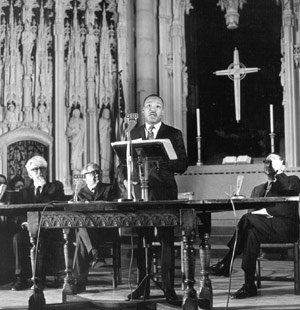
King giving his "Beyond Vietnam" speech in April 1967
Toward the end of his life, Martin Luther King spoke out against the Vietnam War and took on a more radical tone in his criticism of American society. In public remembrances of the man, this chapter of his life is sadly often overlooked. His criticisms remain very relevant today.
      In early June 1967, Ethel Payne covered a speech King gave at the Capital Press Club annual gathering in Washington. The club had been created 24 years ealier because the National Press Club barred blacks from membership.
   There had been considerable debate among the Capital Press Club leaders about having King speak. In April he had come out against the Vietnam War. Since then many of his movement colleagues, including the NAACP, had disassociated themselves from any effort to connect their rights movement with the peace movement. His allies in the white press deserted him, as well. The New York Times said that by fusing race and peace King had done a disservice to both causes. The Washington Post said that his stance had diminished his usefulness to his cause and country.
            Even Payne's newspaper, the Defender, joined the chorus of critics. First, it did so by putting Payne’s account of how GIs viewed the war on the front page a week after King’s speech. In her article, she reported that ninety-nine percent of the men she interviewed while in Vietnam a few weeks earlier supported the war. “Negro soldiers, “ she wrote, “tend to equate the struggle of the Vietnamese people with the civil rights movement at home.”  Eleven days later, the editorial page made the Defender’s views clear. Saying that King “had been swept along by the prevailing tide of hysteria against the war in Vietnam,” the paper predicted, “he will be a shepherd without flock.”  

          “He knew he was under siege for his views,” said Payne who sat not far from him at the club dinner. “As a Negro who knows that the focus of the pro and cons of the war are centered on the American Negro now more than ever, he must have felt that this dinner meeting of the Capital Press Club was a particularly good forum for expressing himself.”
            King began by recalling the halcyon days of the movement in the 1950s and early 1960s and its great legislative victories in 1964 and 1965. “Now, we are moving in a transition period, moving from one phase of the revolution to another,” he said. “We are in a struggle for genuine equality.” The early gains, such as opening hotels, transportation, and restaurants, were won at a “bargain rate,” King continued. Finding jobs for Negroes and eradicating the slums lie ahead. “By this time,” said Payne, “the audience was so quiet one could have heard a mouse running over velvet.”
            In his inimitable slow and rhythmic cadence, King continued. “There must be a radical re-distribution of economic power,” he said.  Whenever the government funds a poverty project in Mississippi, it is labeled creeping socialism. “In this country there is socialism for the rich,” King said. “Only the poor are cast out into the unproductive world of free enterprise.”           
            “By this time,” said Payne, “the audience had come alive and the applause was at steady intervals, but a hush fell again as Dr. King approached the third phase of his speech on the subject of war.” Without mincing words, King repeated his criticism of the war and claimed that women and children have been brutalized and others have been victims of napalm. Charges, that Payne claimed in her coverage of the speech were unsubstantiated and  “indicative of the weak spot in the King logic.”
            But King was not done. “To those who say, why don’t you stick to civil rights and leave the peace issue alone, I say, I refuse to be limited or segregated in my moral concern.” The applause was deafening, said Payne. In her eyes King, the dissenter, had won over the crowd. “When he finished there was a standing ovation and it was clear to the hawks and the doves that ‘the conscience of America’ had spoke clear and firmly.”

Tuesday, January 15, 2013

MLK and Changing Fear of Jail

Working my way through the papers of Louis Martin at the Library of Congress I ran across a perceptive observation that he made about Martin Luther King Jr.  As January 21 is Martin Luther King Jr. Day, I thought I would share it.
     Martin was a long-time editor of the Chicago Defender who worked later in the White House. In his unpublished memoirs, Martin said that King's attitude toward being jailed provided important inspiration to other African-Americans in the emerging civil rights movement. It was not that he would simply tolerate being locked up, but that he went willingly into a jail in the South.
     "For generations all blacks lived in mortal fear of jail," Martin wrote. "The sheriff and the police officers were the twenty-four hour enforcers of the doctrine of white supremacy and the legalized abrogation of the constitutional rights of black folks. The cop on the ghetto corner replaced the boos of the slave plantation for thousands and the sheriff and his posse were indistinguishable in many instances from the Klan leader and his lunch mob."

Monday, December 31, 2012

Daisy Bates Captured in Marvelous Documentary

One of the joys of researching a life is encountering wonderful work by other historians and biographers. In this case I recently had the chance to view Daisy Bates: First Lady of Little Rock that premiered on PBS this year. It is the  story of a seven-year journey taken by filmmaker Sharon La Cruise in hopes of unraveling the life of Daisy Bates who became a household name in 1957 when she fought for the right of nine black students to attend the all-white Central High School in Little Rock, Arkansas.
     La Cruise did a masterful job at making Bates human while retaining an appreciation of her historical significance.  I encourage you to watch the film. You can do easily, as I did, by renting it on line for less than $4 or you can purchase a DVD. Visit La Cruise's website to learn more.
     Ethel Payne came to Little Rock in September 1957 at the height of the standoff between Governor Orval Faubus and the students. She met Bates and the two became life-long friends. Payne also spent an afternoon with the nine black students who were keeping up with their studies while the protesters, courts, and ultimately the President decided their academic fate. "It was a refreshing joy," Payne reported to her readers, "to watch this group of bright uninhibited and unafraid kids calm discuss the situation which swirls around them in the angry bilious patterns of race prejudice."
    The photo below to the left of Payne and Bates was taken maybe in 1981 when Payne stopped in Little Rock for a visit.
     "The house on West 28th is a neat, yellow brick rambler," Payne wrote of her return visit. "It is surrounded by spacious lawns to the rear and side. Red roses climb the wire fence. The street is lined with well-kept, modest homes, typical of the solid citizens who inhabit them. They are the friends and neighbors who keep a protective watch over the occupants of the place. Though not designated yet as a landmark, it is part of history.
    Daisy Bates lives here alone with three cats to keep her company. The house is tastefully furnished, immaculate, and filled with memorabilia--the plaques that lines the walls, trophies on stands, thousands of photographs and books.
     Well, it should be for the frail woman, now in her 60s, has as much to do with the changing pattern of segregation in America as any one single individual. L.C. (Lucius Christopher) Bates the man who stood with her in the long, bitter struggle, is gone now. Death took him last August."
    A few blocks away from the street is Central High School. Nearly 24 years ago, it was the scene of violent confrontations, and resistance to court ordered desegregation. . .
    The front of the school looks the same with the same big letters, 'Little Rock Central High School' and the life-sized painting of a tiger on the wall. All is quiet now. A few blocks away, the woman who made it possible sits stroking her pets and remembering the fire storm that it took to bring about change."

Monday, November 12, 2012

Payne Rejoiced at Washington's Mayoral Election


source: Brent Jones, Amistad Digital Resource
If Ethel Payne were alive today she would be incredulous at the sight of an African American family occupying the White House. In her time, Payne did experience a similar triumph, though on a smaller scale, when a coalition of African Americans, Latinos, and poor whites put Harold Washington into Chicago’s mayor’s office in 1983.
     The victory came in two parts: First, he managed to beat the incumbent mayor, Jane Byrne, and the son of past mayor Daley, Richard M. Daley. Second, frustrated Democrats unwilling to support a black candidate made one last desperate attempt to thwart Washington’s election by supporting the white Republican candidate. For a while the slogan for the Republican campaign was “before it’s too late,” until wiser heads prevailed. The only issue with which they gained traction was that Washington had once done prison time for failing to file federal income tax returns.
     Payne watched the election from her post as a professor at Fisk University. “Like so many of exiles whose hearts have never left Chicago,” she said, “I went ape when it was finally officials that Harold Washington had won the Democratic primary.”
     Payne returned to her native Chicago at the end of April 1983 to attend Washington’s inauguration. A few days later Payne told a friend about the experience. “For me,” she said, “it was quite an emotional experience, something I never dreamed of seeing in my lifetime. Far more than the matter of color is involved here. Despite the repetition and exaggerated accounts of his tax problems, he is a refreshing example of morality in public office. He has courage and integrity, and best of all the strength to hang tough.”

Wednesday, June 13, 2012

Dinners to Remember


Payne with friends in her apartment.
Almost anyone who came into contact with Ethel Payne remembers her dinner parties. For Payne a meal at her place was a way to bring interesting people to the table. Many well-known people host dinners so they can hold court. Not so with Payne. She was the opposite. Her dinner parties were a chance to let others shine.

She chose her guests carefully and from a wide array of people. “Lord only knows who you were going to meet,” said one guest. Normally more than six people were invited. All selected with an eye to create great conversation.

Food was, of course, important. Southern food, lots of greens, sweet potatoes and the like, were often on the menu along with nice wines. “You put Betty Crocker, Aunt Jemima, Maxim’s and the Tour d’Argent all to shame!” wrote one person in a thank you note.

But now twenty-one years after Payne's passing, what the dinner guests remember more is the warmth of the evenings, the good companionship, and, of course, the conversations.

If you want to try one of Payne’s recipes, this one for Chili was found in her papers at the Schomburg Center for Research in Black Culture

ETHEL'S CHILE

Ingredients
  • 1 lb hamburger meat
  • 2 16 oz cans of red kidney beans
  • ½ cup chopped onions
  • ½ cup chopped green peppers
  • 2 cloves chopped garlic
  • 2 tbsp canned pimientos
  • 3 oz grated baker’s unsweetened chocolate
  • salt, Oregon, pepper
  • ¼ cup brown sugar
  • 2 tbsp chili power
  • 8 oz tomato paste mixed with 16 oz tomato puree
 Directions
  1. Cook the hamburger meat and drain off the fat
  2. Saute the onions and green peppers.
  3. Add the garlic
  4. Add all the remaining ingredients and let simmer.
  5. Payne suggests serving it over spaghetti.